AI Agent vs Chatbot vs LLM: Which One Does Your Business Need?
AI agent vs chatbot, LLM and agentic workflow: what each one does, when it fits, and why most companies don't need an autonomous agent to get started.


When a company asks me for “an AI agent,” what they usually need is something else. The short answer to AI agent vs chatbot: a chatbot talks and answers, while an AI agent decides which steps to take and carries them out in your systems until it reaches a goal. Between the two sits an option that gets far less attention than it deserves: the agentic workflow, where you define the steps and the model does the heavy lifting inside each one.
Underneath all of them is the LLM, the language model, which is the engine all three run on.
My take, after seeing a lot of AI projects in sales and operations: almost no company needs an autonomous agent to get started. What they need is a well-designed workflow, with AI in the steps that involve text, judgment, or messy data. The agent comes later, once the process works and is well understood.
Let’s break it down.
What an LLM is and what it can do on its own
An LLM (large language model) is the model that understands and generates text. You give it an instruction and it gives you an answer. That’s it.
On its own, it doesn’t connect to your CRM, send emails, or remember what happened last week. It’s a component, like an engine sitting on a garage floor with no car around it.
Using it directly makes sense when the task is one-off and a person is driving: summarizing a contract, writing a first draft, sorting 200 customer comments pasted into a spreadsheet. You don’t need to build anything for that. You need good judgment in how you ask and how you review what comes back.
What an AI chatbot is and when it fits
A chatbot is a conversational interface. The older ones ran on decision trees (“press 1 for billing”); current ones use an LLM to understand questions written the way people actually write them.
The good ones connect to your information through a technique called RAG (retrieval-augmented generation): before answering, they search your documents and reply with the source cited. We built exactly that for a commercial real estate firm: a private chatbot over thousands of contracts, leases, and compliance files that returns answers with sources and a confidence score. The team stopped digging through folders to settle sensitive questions.
A chatbot fits when the job is answering: customer FAQs, tier-one support, internal questions about policies or documentation. It hits its limit when the answer requires doing something in another system.
What an agentic workflow is (and why it’s the one I recommend most)
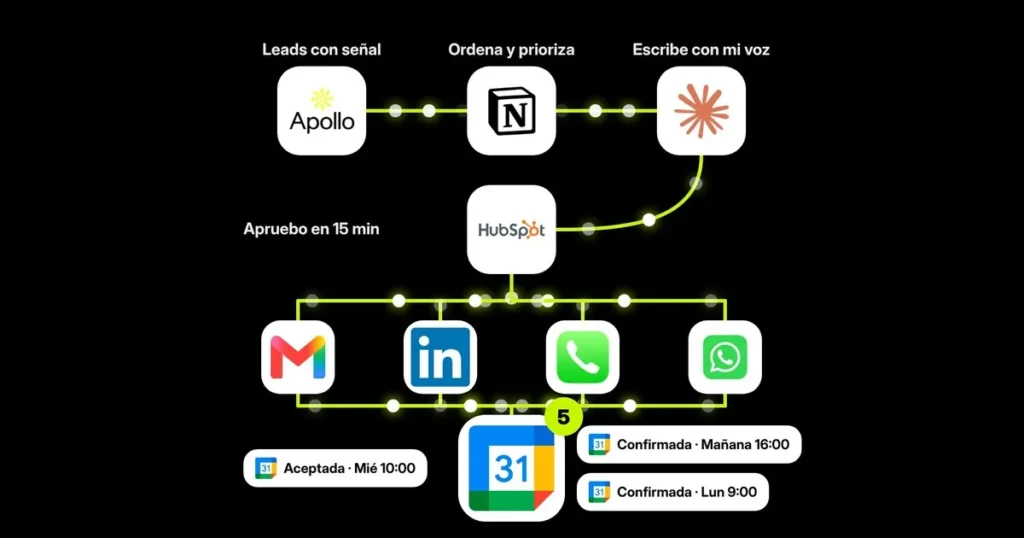
An agentic workflow is a sequence of steps you define, where some of those steps are handled by an LLM. The path is written in advance; the AI handles the parts that used to require a person reading, interpreting, or writing.
Anthropic puts the distinction clearly in its guide Building effective agents: in a workflow, LLMs and tools are orchestrated through predefined code paths; in an agent, the LLM dynamically directs its own process and decides which tools to use. The same guide recommends finding the simplest solution possible and adding complexity only when it demonstrably improves outcomes.
Two examples from projects we’ve delivered:
- Support to engineering handoff. Tickets came in from the help desk and someone rewrote them by hand for the engineering team, losing context along the way. The workflow picks up each ticket, the LLM summarizes it, classifies it, and pulls out the technical detail, and the system creates a structured ticket in the engineering tool. Handoffs became instant.
- Outreach for a legal recruiting firm. Personalized email sequences and, if the contact doesn’t reply, an AI-made phone call. The logic is fixed: email, wait, call if there’s no response. Result: 200 to 300 outreach touches a day with no manual coordination, live in 7 days.
Neither one is an autonomous agent. Both produce measurable results and are easy to audit, because when something breaks you know exactly which step it was.
What an AI agent is and when you actually need one
An AI agent gets a goal instead of a list of steps. It decides what to do, uses tools (query a database, read an email, write to the CRM), looks at the result, and decides again, until it’s done or something stops it.
That’s powerful when the path changes from case to case and can’t be drawn as a flowchart. Think researching a prospect whose information is scattered across different sources, or resolving a customer complaint that requires checking three systems in an order that depends on what turns up.
It also comes with costs that rarely make it into the sales pitch:
- It’s less predictable. Two similar cases can take different paths.
- It costs more per task, because the model reasons and calls tools several times before reaching an answer.
- It’s harder to audit, because the mistake can sit in any intermediate decision.
That’s why, when we build multi-agent systems, like a marketing platform for a specialty retailer with content and cross-selling agents tied into its ERP, we keep human approval before anything is published. Autonomy is earned over time.
Gartner projects that over 40% of agentic AI projects will be canceled by the end of 2027 due to escalating costs, unclear business value, and inadequate risk controls. The same release flags “agent washing”: vendors rebranding chatbots, assistants, and RPA as agents. Gartner estimates only about 130 of the thousands of vendors claiming agentic capabilities are the real thing.
AI agent vs chatbot vs LLM vs workflow: comparison table
| LLM on its own | Chatbot | Agentic workflow | AI agent | |
|---|---|---|---|---|
| What it does | Generates or analyzes text on request | Holds a conversation and answers questions | Runs fixed steps with AI inside some of them | Chooses its own steps to reach a goal |
| Who decides the path | The person using it | The user, question by question | You, when you design the workflow | The model |
| Takes action in your systems | No | Little or none | Yes, at defined points | Yes, wherever it has permissions |
| Predictability | High (a human reviews) | Medium | High | Low to medium |
| Typical example | Summarize a contract | Answer customer questions 24/7 | Classify tickets and create them in another system | Research and qualify leads across shifting sources |
| Choose it when | It’s a one-off task with a person driving | The job is answering | You can draw the process | The path changes every time and mistakes are reversible |
How to choose between a chatbot, a workflow, or an AI agent
Before talking technology, ask these questions in order. The first one you answer yes to tells you where to start.
- Is it a task one person does now and then? Use an LLM directly and teach the team to prompt well. Don’t build anything yet.
- Is the work mostly answering questions about information that already exists? A chatbot connected to your documents.
- Can you sketch the process on a whiteboard, steps and exceptions included? An agentic workflow. That’s the answer for most of the operations and sales processes we see.
- Does the path change so much it can’t be drawn, and can a mistake be fixed cheaply? Then yes, an AI agent, with clear limits and a person approving sensitive actions at first.
If you got to question 4 with a process that has never worked well manually, stop there. Automating a messy process gets you the same mistakes, only faster and at scale.
The most expensive mistake: starting with the agent
What I see most, both with US mid-market companies and in Latin America, is enthusiasm running backwards. Teams start with the most complex option because it’s the one everyone’s posting about, and the process it was supposed to automate was never mapped.
The order that works for us is the opposite. First, understand how the company makes money and where time is lost. Then solve the most repetitive part with a workflow you can measure. Only once that workflow runs well and edge cases show up that don’t fit the rules do you add an agent to handle those exceptions.
That’s how we work at RevAI: we start by listening to the process, build the simplest piece that moves a business number, and stay on to make it perform. If you’re deciding who to build it with, this guide on how to choose an AI implementation partner can help.
Frequently asked questions
Is ChatGPT a chatbot or an AI agent?
In everyday use it’s a chatbot built on an LLM: you talk, it answers. When you turn on features that let it browse, run code, or act in other apps, it starts behaving like an agent, because it decides which tool to use to get done what you asked.
What’s the difference between agentic AI and an AI agent?
Agentic AI is the broad term for systems where AI makes decisions and takes actions with some degree of autonomy. An AI agent is a specific implementation of that idea: a system with a goal, a set of tools, and the ability to choose its own steps.
Can a chatbot become an agent?
Yes, if you give it tools and permission to use them. A support chatbot that can also check an order’s status and process a return is already acting as an agent. That’s why you should define from day one which actions it can take on its own and which need approval.
Which costs more to implement, a chatbot or an AI agent?
Generally the agent. It needs integrations with more systems, more testing, monitoring of its decisions, and a higher usage cost per task. A tightly scoped agentic workflow usually lands in between, with a return that’s easier to measure.
Where should I start if I want to automate a process with AI?
With the process. Pick one that’s repetitive, has a clear owner, and is tied to a number you want to move (hours, response time, conversion). If you’d like to walk through it with us, book a call and we’ll figure out which piece to build first.