How to Choose an AI Implementation Partner When Anyone Can Build
How to choose an AI implementation partner when building software keeps getting cheaper: where the real value sits, a $700K lesson, and what to ask.


If you’re working out how to choose an AI implementation partner, start by getting skeptical of the line you’ll hear most: “we build anything.” Almost any technical team can say that today and mean it. What’s rare is knowing what to build, for which process, and whether it should be built at all.
The short answer: pick the firm that understands how your company makes money before anyone writes code, and that has engineers behind it who can deliver at enterprise level. Either half on its own will cost you.
Why “we build anything” stopped meaning much
Building software keeps getting cheaper. In a controlled experiment by researchers from Microsoft, GitHub and MIT, developers using an AI pair programmer finished the same task 55.8% faster than those working without one (Peng et al., 2023). Model costs fell even faster. Stanford’s 2025 AI Index reports that running a model at GPT-3.5 level got more than 280 times cheaper between November 2022 and October 2024.
When building costs less, more builders show up. Automation agencies, dev shops, freelancers wiring up agents, offshore software factories that added “AI” to their homepage. Everyone wants a slice, and the value of a firm that only builds gets diluted.
We see it from the inside. At RevAI we work with engineers who have spent 5 to 7 years building for top-tier, Nasdaq-listed tech companies. World-class talent working out of India, available by the hour, at a price that would have sounded absurd ten years ago. If that level of engineering is that accessible, code is no longer the hard part of the project.
Delivery still is. Getting what you built adopted, moving a business metric with it, and keeping it running six months later is where most projects break.
What the data says about AI projects that fail
MIT NANDA’s 2025 report The GenAI Divide found that roughly 95% of enterprise generative AI pilots deliver no measurable revenue impact (Fortune). Model quality had little to do with it. Poor integration into company workflows and tools that never adapt to how people actually work did most of the damage.
The same research found that solutions bought from specialized vendors or built through partnerships succeeded about 67% of the time. Purely internal builds succeeded about a third as often.
Put plainly, the model is the cheap part. Understanding the process it has to live inside is the expensive part.
The brilliant engineer who has never seen a pipeline
I watched this one up close. A technically excellent dev team built an AI training platform for companies in Latin America. Enterprise-grade, intuitive, well made. The price: $800 per seat, in a market where mass-market AI courses sold for under $30.
Nobody checked whether the market wanted it. It was built on FOMO, out of fear of “losing the market.” A team of 40+ people pushed for months on a product no customer had asked for. By the time the market answered, more than $700K was gone for good.
The offer was reworked and the price dropped to $99 per seat to cover costs. By then perceived value had already collapsed. A product sold at $800 and then at $99 tells buyers it was never worth $800.
The engineering held up. What was missing was someone asking, before any code, who buys this, at what price, and against what alternative.
Automation works the same way. A strong AI engineer can build a lead-scoring agent in an afternoon. If they’ve never run a funnel, they won’t know that the “low score” lead the agent drops might be the one your best rep closes in a week because she knows the plant manager. The agent works and the business gets worse.
The industry consultant who doesn’t know the technology
The opposite profile exists too. Consultants with twenty years in mining, logistics or healthcare who know every bottleneck in the operation, yet treat AI as a black box. They tend to make one of two mistakes: asking for automations today’s technology handles badly, or underestimating what can now be done in weeks and still scoping year-long programs.
Their edge is judgment. They know where AI fits, where it doesn’t, and whether an integration is needed in the first place. Often the best call is to wait and clean up the process first. A team paid to build will rarely tell you that.
As an advisor and fractional CRO, I’ve seen this gap across dozens of sales and marketing teams. I’ll take a strong consultant who knows AI over an AI engineer who has never looked at a funnel or a pipeline, every time. You can teach the first one the tools in weeks. Commercial judgment takes the second one years of running teams, missing quota and losing customers.
Where the value sits: strategic judgment plus top-tier delivery
Here’s what happens when both halves work together. On a sales team I advised, lead generation was outsourced to an agency charging $15,000 a month and booking an average of 4 meetings a week.
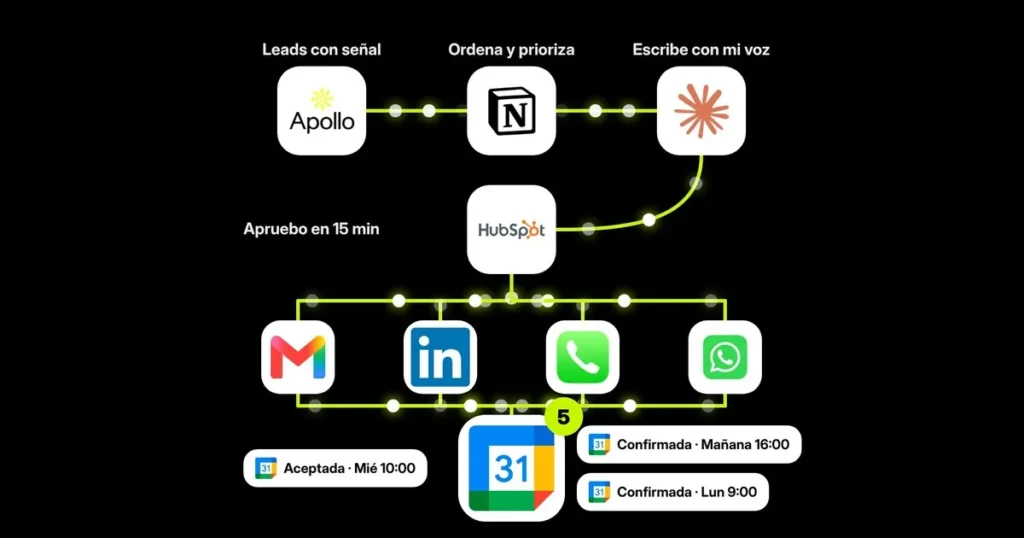
We redesigned from the pipeline before touching any tool: who we were talking to, which signal meant an account was ready, and what had to happen for a meeting to move forward. With that settled, we put together a stack for about $250 a month and added a part-time SDR for $700. Total cost: roughly $950 a month. Some weeks brought up to 11 meetings, against the agency’s 4.
Anyone could have bought the tech in that stack. The result changed because someone knew what to measure and where to put the person.
That combination is hard to find. Large strategy firms usually bring the judgment, then outsource delivery and bill as if they didn’t. Many automation agencies can deliver but have never run an operation. The value sits right where the two meet.
| AI engineer without industry experience | Industry consultant with some AI knowledge | Strategic judgment + senior engineering | |
|---|---|---|---|
| Strength | Builds fast, with solid technical quality | Knows what hurts in the operation and what moves margin | Decides what to build and delivers it well |
| Typical risk | Automates the wrong process | Asks for what tech can’t solve, or scopes projects too long | Rare: verify both halves actually exist |
| First question asked | What do you want me to build? | Where are you losing money? | Where are you losing money, and which part can AI fix today? |
| Likely outcome | A system that works and nobody uses | A good diagnosis that never gets implemented | A changed process and a metric that moves |
That’s how we run engagements at RevAI: first we learn how your operation makes money and where AI changes that number, and only then do we build with senior engineers who have shipped at that level.
How to choose an AI implementation partner: questions for the first meeting
These questions quickly filter out firms that only sell development hours:
- Who on your team has run an operation like mine, and for how long? Ask for names and titles, not logos.
- What would you advise me not to automate? If the answer is “everything is possible,” take note.
- Which number in my business should move, and when will we measure it?
- Who builds it, how experienced are they, and who answers when something breaks in production?
- How do we validate demand or impact before committing the full budget?
- What happens after launch with team adoption and adjustments?
- Can you show me a case where you recommended stopping or shrinking a project?
The last one filters hardest. A team that has never recommended a smaller project is probably paid by size.
Frequently asked questions
Should we build AI in-house or work with an outside partner?
It depends on whether your team has already shipped AI to production. In MIT NANDA’s research, solutions built with specialized vendors or partners succeeded about 67% of the time, versus about a third of that rate for purely internal builds. A hybrid setup, where the partner transfers know-how to your team, usually lowers the risk of a first project.
What’s the difference between an AI consulting firm and an automation agency?
An agency executes what you ask for. A good consulting firm starts by questioning whether that’s what you need, defines which metric should move, and then builds or manages the build. If nobody asks about your commercial or operating metrics in the first meeting, you’re talking to an agency.
Can an AI agency do good work in any industry?
It can build for any industry. Getting what to build right is another matter. In mining, logistics or healthcare, processes come with constraints (shift patterns, regulation, legacy systems) that only people who have operated there know well. Ask for direct experience in your sector and for measurable cases.
How do I know if a process actually needs AI?
Start with what the problem costs: hours, errors, lost deals. If the process is messy or depends on data nobody maintains, AI will automate the mess. Often the first useful step is fixing the process, and AI comes in after.
If you want to see where AI would actually move a number in your operation, with someone who has run sales teams and an engineering team that ships, let’s talk.